Why Skills Matter More Than Degrees Today?
Introduction
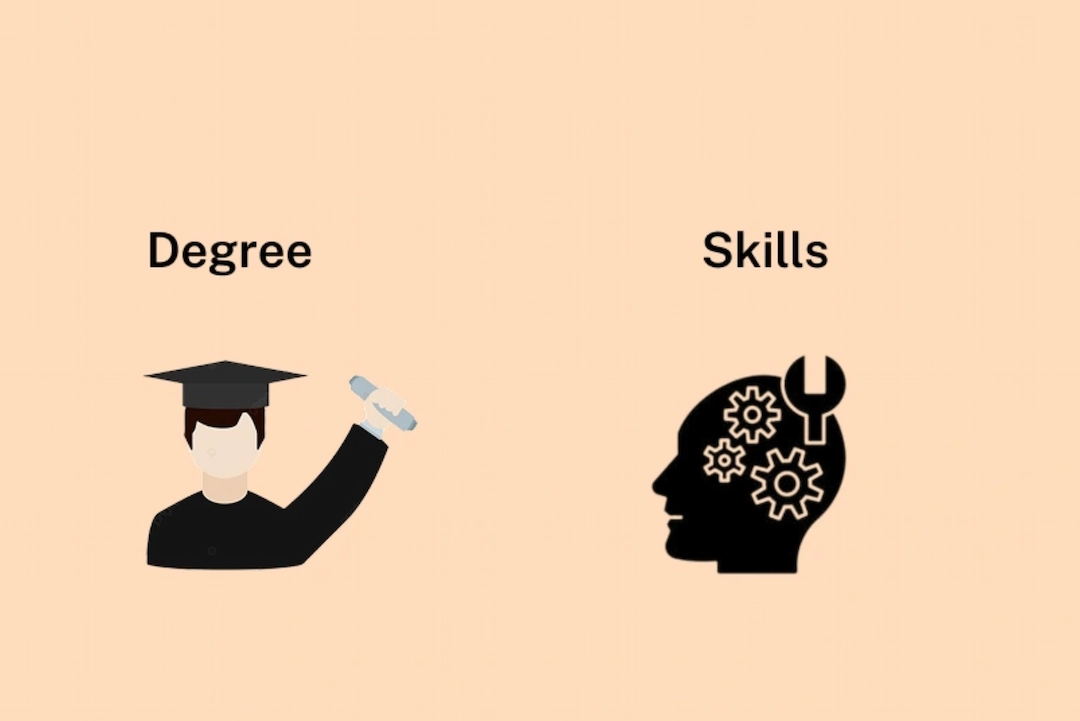
In today’s fast-evolving professional landscape, the traditional emphasis on degrees as the primary measure of employability is gradually giving way to a skills-first approach. While education provides foundational knowledge, practical skills, adaptability, and problem-solving abilities have become the real differentiators in the job market. This shift is driven by rapid technological changes, industry demands, and evolving work cultures, making the mastery of relevant skills more crucial than ever. Here’s why skills matter more than degrees today.
1. Changing Industry Requirements
The modern workforce is no longer limited to conventional roles. Industries are
continuously adapting to technological advancements, automation, and AI integration. As a
result, companies increasingly value employees who can apply practical knowledge and
learn new skills quickly, rather than relying solely on formal degrees.
For instance, in fields like software development, data analytics, digital marketing, or AI,
employers often prioritize hands-on experience, portfolio projects, and coding proficiency
over a formal degree. Many successful professionals in tech have thrived through self-learning,
bootcamps, and certifications rather than traditional academic paths.
Key takeaway: Employers want people who can deliver results, not just those with a certificate
on paper.
2. Degrees Don’t Guarantee Job Readiness
A degree demonstrates academic knowledge, but it doesn’t always reflect a candidate’s ability
to perform in real-world scenarios. Many graduates struggle to transition from theoretical
learning to practical execution.
Skills such as problem-solving, critical thinking, communication, collaboration, and
digital literacy are often what distinguish top performers. A person with a relevant skill set can
often outperform someone with a degree but lacking experience or applied expertise.
Example: A marketing graduate may understand concepts but might fail to run a successful
social media campaign, whereas a self-taught marketer with proven campaign experience could
deliver immediate value.
Key takeaway: Skills bridge the gap between knowledge and performance.
Rapid Technological Change Demands Lifelong Learning
The modern job market is dynamic and fast-paced, with new technologies emerging every
year. Traditional degrees are often static, taking years to complete and occasionally becoming
outdated.
In contrast, skills-focused learning is flexible, adaptive, and continuous. Platforms like
Coursera, Udemy, and LinkedIn Learning allow professionals to acquire relevant skills quickly
and remain competitive. Employees who invest in upskilling and reskilling are far more valuable
to employers than those relying solely on their degree.
Key takeaway: Continuous skill development ensures career longevity in a world where
knowledge evolves rapidly.
4. Types of Job Markets
Employers today assess candidates based on their ability to solve problems, innovate, and produce tangible results. Practical skills demonstrate competence, initiative, and adaptability.
        Top in-demand skills include:
            ● Digital literacy and coding
            ● Data analysis and visualization
            ● Communication and presentation
            ● Project management and teamwork
            ● Creativity and innovation
Having these skills makes candidates job-ready from day one, reducing training costs for
employers and increasing productivity.Example: In the IT sector, certifications in cloud computing, cybersecurity, or AI often hold more weight than a general computer science degree because they reflect the employee’s capability to perform specialized tasks.
Key takeaway: Skills make candidates immediately effective and valuable in the workplace.
5. Skills Promote Entrepreneurship and Freelancing
The rise of the gig economy and entrepreneurship has further shifted the focus from degrees to
skills. Many freelancers, consultants, and startup founders succeed based on their ability to
execute and innovate, not the degrees they hold.
Example: Graphic designers, content creators, web developers, and digital marketers can build
entire careers through skill acquisition, portfolio development, and client success, without ever
pursuing higher education.
In this context, practical skills open doors to independent income streams, career flexibility,
and global opportunities that a degree alone cannot guarantee.
Key takeaway: Skills empower individuals to create opportunities rather than just seeking them.
Conclusion
In conclusion, the professional world is shifting from credential-based hiring to
capability-based evaluation. While degrees provide foundational knowledge and social
credibility, skills determine employability, productivity, and career growth. Employers
prioritize candidates who can deliver results, adapt to change, and continually upskill
themselves.
The message is clear: Invest in developing practical, relevant, and adaptable skills.
Whether through online courses, certifications, projects, or self-directed learning, skills will
always hold more weight than degrees in today’s fast-paced, results-driven professional
landscape.